CNF's position on the UK SAF Mandate

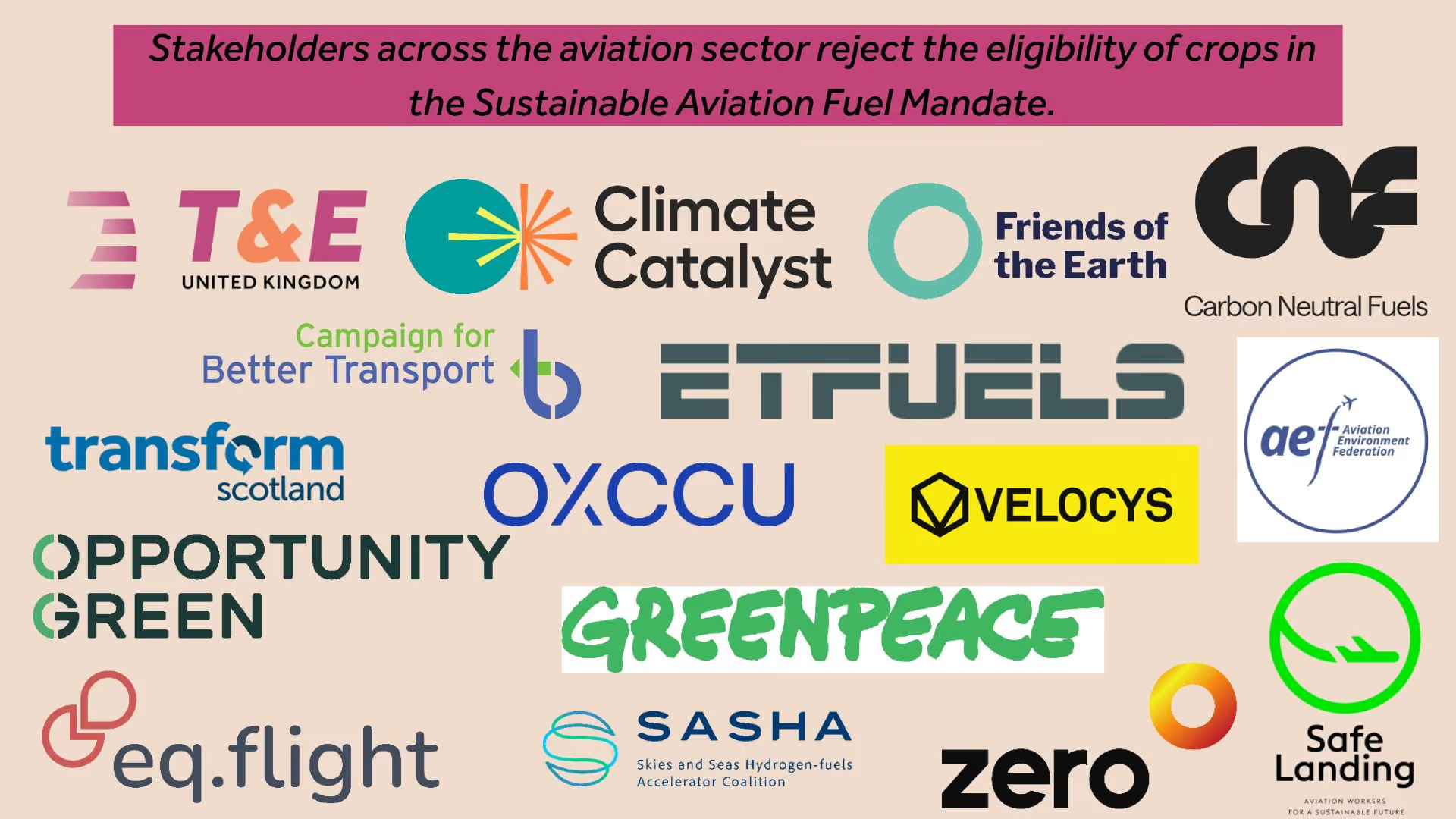
On the 9th of February 2026, we signed a joint letter to the Secretary of State for Transport setting out our view on the UK Sustainable Aviation Fuel (SAF) Mandate.
The mandate was carefully designed to drive investment into advanced, scalable fuel pathways with strong long-term decarbonisation potential. As the Government reviews aspects of its implementation, we believe it’s important to maintain policy clarity and ensure the framework continues to function as intended.
We’re working alongside industry partners to help ensure the SAF Mandate supports genuine innovation, strengthens investor confidence, and accelerates the deployment of sustainable fuels that can deliver lasting emissions reductions.
You can read the full letter, including the list of signatories, below.
Dear Secretary of State,
CC: Rt Hon Ed Miliband MP, Rt Hon Peter Kyle MP, Rt Hon Emma Reynolds MP, Rt Hon KierMather MP, Rt Hon Chris McDonald MP,
Appeal to reject eligibility of crops in the Sustainable Aviation Fuel Mandate
We, the undersigned, write to express our concern about the Government’s newly released call for evidence on the eligibility of crops in the Sustainable Aviation Fuel (SAF) Mandate.¹
The SAF Mandate has been carefully designed to prioritise fuels with the greatest long-term decarbonisation potential, notably through the power-to-liquid (PtL) sub-mandate, while constraining less sustainable pathways through the HEFA cap and the exclusion of crop-based biofuels. Reopening the mandate so soon after its introduction would risk undermining its credibility at a critical early stage, creating the perception that the policy is already under strain before it has had time to operate as intended. Allowing crop-based biofuels to qualify asSAF would represent a backward step that risks weakening investor confidence in newer, more scalable fuel pathways.
The exclusion of crops from SAF eligibility is long-standing and deliberate. In its 2023 consultation, the Government committed to supporting only SAF made from wastes, residues or low-carbon energy in order to avoid deforestation and competition with food². This position was reaffirmed in February 2025, when the Government confirmed that the mandate “prevents the diversion of resources away from food production” and that fuels made from food, feed or energy crops are not eligible³. This approach aligns with the EU’s ReFuelEU Aviation framework, which similarly excludes food and feed crops. Maintaining this consistency is important for policy coherence and credibility.
The core issue with crop-based fuels is land demand. Using primary crops for aviation fuel directly links aviation decarbonisation to agricultural land, a finite and increasingly constrained resource. A clear principle of “no primary crops for fuel” is therefore essential: when crops are not diverted into fuel markets, land can instead support food production, nature restoration or carbon sequestration.
Claims that crop-based SAF could be environmentally neutral if limited to bioethanol “made available” from declining road fuel demand are not credible in practice. Biofuel markets areglobal and fungible, and it is not technically feasible to demonstrate that ethanol used in aviation is in fact the ethanol made available by reduced use as a fuel in road transport. Introducing aviation demand would instead sustain overall demand for crop-based fuels, locking inland use rather than freeing it up.
Once indirect land-use change and lost carbon sinks are taken into account, crop-based biofuels offer limited or even non-existent emissions savings⁴. They often rely on monocultures that harm biodiversity and can increase pressure on staple food prices. Meeting the SAF Mandate with crop-based fuels in 2030 would require land equivalent to around 4% of all UK agricultural land, posing clear risks for a just transition for both society and nature.
Calls to allow British crop-based bioethanol to qualify under the SAF Mandate are driven in part by increased competition from US producers following the US-UK Trade deal⁵. However, restricting eligibility to domestic bioethanol would constitute a significant market distortion and could be incompatible with international trade law. Conversely, allowing imported bioethanol to qualify would likely enable US producers to out-compete UK suppliers, without delivering clear benefits to the British bioethanol industry.
If the 1.4 billion litres of bioethanol currently used in UK road transport were to become eligible as SAF, this could represent around 3.2% of total aviation fuel demand, potentially flooding the market with lower-cost fuels and undermining investment across other SAF pathways.Rather than reclassifying crop-based fuels as “sustainable”, government support should remain focused on the highest-integrity alternatives to fossil kerosene, particularly power-to-liquid fuels. These pathways offer far greater long-term economic and strategic value, with the potential to generate up to 60,000 UK jobs by 2050 and £10 billion in annual gross value added⁶.
Diluting SAF eligibility rules at this early stage would reduce investor confidence in theGovernment’s commitment to advanced SAF producers, undermining the effectiveness of the SAF Revenue Certainty Mechanism and risking the UK’s opportunity to establish a domestic second-generation SAF industry. This risk is particularly acute given that public funding is limited and should be reserved for the technologies that most decisively rely on early-stage support. Power-to-liquid fuels also offer wider system benefits. As renewable electricity capacity continues to expand faster than grid and flexible infrastructure, PtL production can help absorb excess renewable generation while supporting aviation decarbonisation.
The SAF Mandate is beginning to deliver with existing eligible feedstocks, with DfT production data for 2025 showing SAF accounting for 1.6% of fuel supplied for UK flights during the early phase of implementation⁷. As with other successful transport decarbonisation policies, it should be allowed to operate as designed until its first formal review point in 2030. Weakening eligibility criteria now would undermine policy credibility, environmental integrity and the UK’s long-term industrial opportunity.
We therefore urge the Government to maintain the exclusion of crop-based fuels from theSAF Mandate and to focus support on the scalable, high-integrity fuel pathways that can deliver lasting emissions reductions and economic value.
As committed and constructive stakeholders, we stand ready to engage with the Government on the effective implementation of the SAF Mandate, including the timely deployment of the SAFRevenue Certainty Mechanism and the development of a robust UK SAF industry based on sustainable and scalable feedstocks.
Yours sincerely,

¹ Department for Transport, SAF Mandate: crop-derived sustainable aviation fuel, 22 December 2025
² Department for Transport, Pathway to net zero aviation: Developing the UK sustainable aviation fuel mandate, March 2023, p.9
³ Department for Transport, Response to Parliamentary Question 28800, 12 February 2025
⁴ Cerulogy, How e-fuels can mitigate biodiversity risk in EU aviation and maritime policy, November 2024
⁵ Renewable Transport Fuel Association, NOW is the time to allow crop-based British Bioethanol in theSAF mandate”, 4 August 2025
⁶ UK Sustainable Aviation, Roadmap for the development of the UK SAF industry, April 2023
⁷ Department for Transport, Sustainable Aviation Fuel (SAF) Mandate statistics 2025: Second provisional release, 13 November 2025

Sign up to our newsletter for all of our latest news and updates.