eSAF and Energy Security in a Volatile World
This article was originally published on New Energy Weekly.
Last year, Energy Secretary Ed Miliband spoke about the need to get off the ‘fossil fuel rollercoaster’ to reduce the UK’s financial and physical exposure. ‘Homegrown clean energy,’ he opined, ‘cannot be weaponised by dictators or petrostates’. Since then, the cost of that vulnerability has been writ large on every screen, newspaper, and supermarket receipt. Fuel prices have squeezed already struggling Britons and served as a stark reminder that energy security undercuts every aspect of our lives.
There’s a tendency among the older generation to assume that the genie will always go back in the bottle. After all, this is hardly the first time that conflict in Europe or the Middle East has caused shortages at home, and it's always been followed by an inevitable economic bounce-back. Except what if the ever increasing frequency of these rumblings is signalling something else? For my generation, fuel security has been omnipresent. We’ve been importing most of our consumed energy in the UK since my primary school days, and in the background of my childhood memories there was often a real or imagined threat of fuel shortage on the news. Since starting Carbon Neutral Fuels three years ago that background noise has become a cacophony. Speaking on the fuel shortages caused by the Iran conflict, the International Energy Agency Executive Director, Dr. Fatih Birol, put the feeling so many of us are experiencing into words:
"The vase is broken, the damage is done - it will be very difficult to put the pieces back together. This will have permanent consequences for the global energy markets for years to come."
I came to sustainable aviation fuel from the broader sustainability space. Working in nuclear and volunteering for Net Zero groups had led me to COP26, where I met Alasdair, my co-founder. The vision and heart of our company has always been to allow the connectivity of flight whilst minimising the damage to the climate, and I’ve been open about my views that the climate threat is the most severe one facing the globe. Yet the sustainable credentials of our product (Power-to-Liquid eFuel) are no longer the aspect I find myself trying to explain. It’s supply chain security.
Over 70% of our aviation fuel is imported from overseas. In just one example, the latest fuel crisis has meant postponing closing a loophole that means that Russian crude is still making its way into our planes. In return, British pounds are making their way into Russian war chests. I’m no fan of Kemi Badenoch’s policies but there’s little doubt she’s correct that ‘choosing to buy dirty Russian oil (will) fund the killing of Ukrainian soldiers’. Surely there’s a clear argument for supporting our developing supply chain, to ensure we never have to face a moral dilemma like this again.
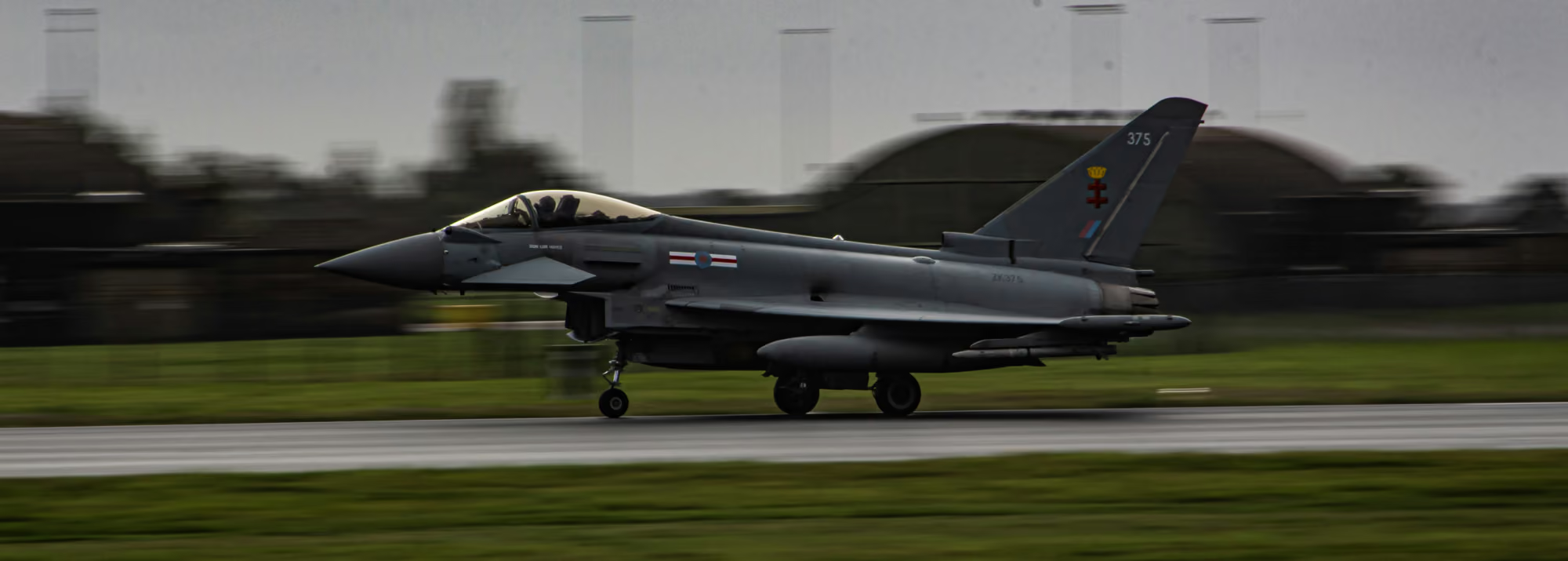
The Telegraph recently published an expose revealing that the RAF will spend more than £1 billion over the next 15 years adhering to the government’s SAF mandate, which has predictably caused a flurry of anti Net-Zero sentiment. Yet analysing this purely as an eco-compliance exercise is missing a key point. Surely the attraction of an indigenous fuel supply utilising little to no imported feedstocks is self-evident to an island nation. It's an argument proponents of North Sea drilling have been making for years - domestic supply means domestic security - yet it’s rarely, if ever, applied to discussions of eFuel. And eFuel has the advantage of not contributing to a problem that increases the threat of conflict on the global stage - a climate change reality long warned of by defence think-tanks and military strategists alike.
As a founder of one of the UK’s leading eFuels companies, of course I have an industry bias but I have no financial horse in this specific race; Carbon Neutral Fuels is not part of the RAF's deal. I’m writing this only because the discussions I’ve seen ignore this key point. Directing a portion of our defence budget toward fuel produced in the UK, using resources abundant in the UK, and made by workers in the UK, who will spend in the UK is common sense, for our security and our economy. Regions like Cumbria (where we’re building our flagship facility) or the Scottish Highlands have abundant windpower and water, carbon sourced directly from rural industries, and young people who want meaningful work.
The Telegraph noted that the £1 billion figure could have otherwise been spent on ‘12 F-35 Lightning stealth fighters’. What good those might be, grounded, in a UK increasingly cut off from fuel supply by hostile States near and far was not discussed. Neither was the fact that the US defence giant Lockheed Martin (who makes the F-35s) has already been contracted to produce over 140 of the things since 2015, at a cost to the British taxpayer, and with far less flowing into local economies. Sacrificing the cost of 12 more for a clean, green, homegrown jet fuel supply to keep them running seems like a remarkably shrewd trade-off. After all, a stealth fighter is only a deterrent if it actually has the fuel to leave the tarmac.
–
Sophie Zienkiewicz is a co-founder and Director at Carbon Neutral Fuels, an eFuels company developing a PtL aviation fuel facility in Cumbria. The facility is on track to begin production in 2031, capable of creating upwards of 25,500 tonnes of ASTM-compliant synthetic blend component each year, and supplying more than 35% of the UK’s mandated eSAF.
The views expressed are the author’s own and may not reflect the views of Carbon Neutral Fuels.
Sources:


Sign up to our newsletter for all of our latest news and updates.